
VayuCast: Low-Cost, Locally Built Sensors for Microclimate Monitoring in Nepal
How the VayuCast project is using affordable, locally assembled sensors to collect and share real-time microclimate data in Gaur and Siraha, Nepal.
- Vayucast
- Nepal
- Microclimate Monitoring
- Local Manufacturing
- Low-cost Sensors
- Environmental Monitoring
- Gaur
- Siraha
- Sensor.community
- Community Data
- Published
- Reading time
- 3 min read
- Author
- Saroj Chaudhary
- Role
- IoT & Embedded Systems Engineer
Weather conditions can change noticeably from one neighborhood to another. In cities and municipalities, factors such as buildings, roads, vegetation, and open spaces can create different local temperature and humidity conditions. Yet these small variations are not always visible in data collected by a limited number of conventional weather stations.
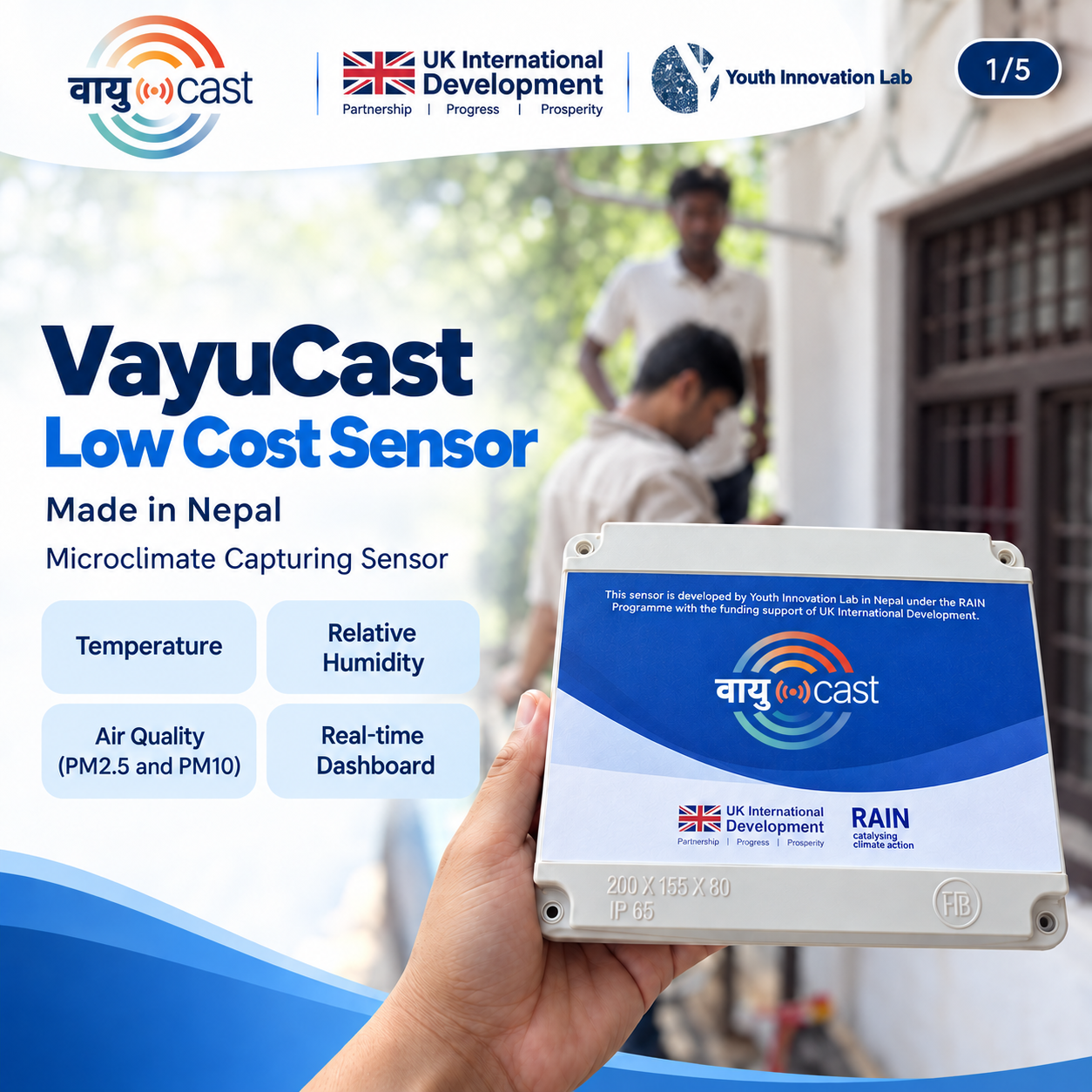
This is where VayuCast, a low-cost microclimate sensor project developed by Youth Innovation Lab in Nepal, offers a practical approach: build monitoring devices locally, place them closer to communities, and make the collected data accessible.
The project is being implemented under the RAIN Programme, with funding support from UK International Development. I am proud to have contributed to this work and to the development of practical IoT systems for local environmental monitoring.
Why Local Microclimate Data Matters
Weather reports are useful for understanding conditions across a wider area, but they may not fully represent the conditions experienced at a specific school, street, neighborhood, or settlement.
A network of local sensors can help reveal these differences by collecting measurements at multiple locations. Over time, the data can support a better understanding of local temperature and humidity patterns, including conditions relevant to heat exposure and community planning.
The aim is not to replace official weather stations, but to complement wider observations with more location-specific information.
Building Affordable Sensors Locally
One important part of VayuCast is the focus on low-cost hardware and local development.
Instead of relying only on expensive, fully assembled monitoring equipment, this approach uses accessible electronic components that can be integrated, programmed, assembled, tested, and maintained locally. It creates opportunities to adapt the sensor hardware, firmware, power system, and communication method to the conditions at each deployment site.
Local assembly is not the same as manufacturing every electronic component in Nepal. The practical value comes from developing local skills and capabilities to build, customize, repair, and improve the devices without depending entirely on imported finished systems.
Keeping costs manageable also makes it more realistic to deploy multiple sensors across different locations. But affordability alone is not enough: sensor placement, calibration, weather protection, connectivity, and regular maintenance remain essential for useful data.
16 Sensors Collecting Data in Gaur and Siraha
At the time of this update, 16 VayuCast sensors are live in two municipalities in Nepal:
| Municipality | Live sensors |
|---|---|
| Gaur Municipality | 11 |
| Siraha Municipality | 5 |
| Total | 16 |
These devices continuously record local microclimate conditions and transmit readings for remote monitoring. By distributing sensors across different locations, the project is developing a growing dataset that can help show how environmental conditions vary within and between communities.
From Local Sensors to Open Data
Collecting measurements is only one part of the work. The next step is making that information available in a useful way.
VayuCast readings are transmitted for real-time viewing through a web dashboard and the public Sensor.Community platform. This allows people to explore observations from deployed locations instead of keeping the information only on individual devices.
The approach connects three important elements:
Locally built sensors → Internet-connected monitoring → Publicly accessible environmental data
Open access also creates opportunities for students, researchers, local governments, and community groups to explore the readings, ask questions, and identify patterns. The data still needs appropriate quality checks and interpretation before being used for important decisions.
What Comes Next?
With sensors now operating in Gaur and Siraha, the next phase will focus on analyzing the growing dataset and exploring how local measurements can provide practical insights.
Potential areas of analysis include comparing conditions across sensor locations, studying changes over time, and identifying where additional monitoring could be useful. These are future possibilities, rather than findings already established by the current deployment.
For me, VayuCast shows why local data and local hardware capability should grow together. A low-cost sensor is valuable not just because it measures the environment, but because it can be built, improved, maintained, and used by the communities and teams working with it.
Explore the live sensor data: View the VayuCast monitoring dashboard.
More updates on the deployment, hardware improvements, and data analysis will follow.