
The Future of IoT in Nepal: Edge AI, Smart Sensors and Connected Systems in 2026
Explore the IoT technologies shaping Nepal in 2026, from Edge AI and smart sensors to 4G, LoRa, local hardware development, and real-world deployments.
- IOT Trends 2026
- Internet OF Things Nepal
- Edge AI
- Tinyml
- ESP32
- Embedded Systems
- Smart Sensors
- Lorawan
- 4G LTE
- IOT Connectivity
- Local Hardware Development
- Environmental Monitoring
- Smart Agriculture
- Digital Transformation
- Published
- Reading time
- 12 min read
- Author
- Saroj Chaudhary
- Role
- IoT & Embedded Systems Engineer
The Internet of Things (IoT) in 2026 is moving beyond connecting a sensor to Wi-Fi and displaying its readings on a dashboard. Connected devices are becoming more capable of processing data locally, recovering from network problems, receiving remote updates, and supporting practical decisions. The important shift is not simply toward more connected devices. It is toward more reliable, useful, and maintainable IoT systems.
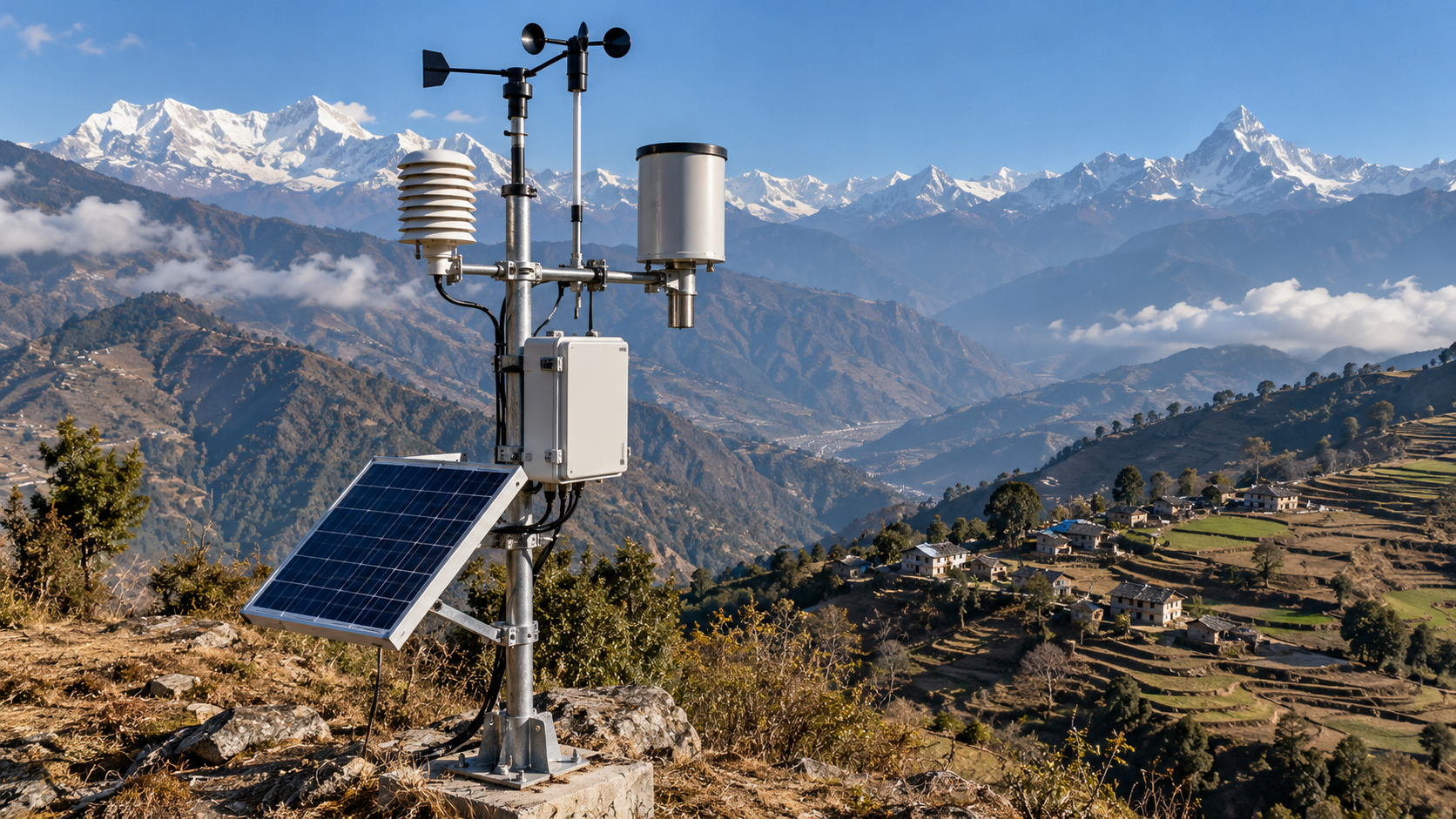
For Nepal, this change is particularly relevant. A device installed in a laboratory in Kathmandu faces different challenges from one deployed on a farm, beside a river, or in a remote municipality. Connectivity, electricity, environmental conditions, cost, and access to maintenance can determine whether a system remains useful after the first demonstration.
This article looks at the major IoT technology trends in Nepal in 2026, which technologies are realistic to implement today, and where local engineering can make the biggest difference.
1. From Cloud-Only IoT to Edge AI and Local Intelligence
In a traditional IoT setup, a sensor sends readings to a server, and the server processes the information. This remains useful, especially when large datasets and historical analysis are involved. But sending every reading to the cloud is not always necessary.
Edge computing means handling some processing close to where the data is generated. For example, an ESP32-based device can calculate a threshold, filter noisy measurements, or turn on a pump without waiting for an internet connection. Edge AI goes further by running a trained machine-learning model directly on a device or nearby gateway.
Potential examples include:
- Detecting unusual equipment vibration before a breakdown.
- Recognizing patterns in sensor readings rather than applying only fixed thresholds.
- Processing simple audio or visual information locally.
- Reducing the amount of raw data that must be transmitted.
- Continuing essential decisions while connectivity is unavailable.
Microcontrollers such as the ESP32-S3 make some lightweight on-device inference possible. Espressif provides Edge AI examples and development resources for these types of applications. However, a small microcontroller cannot run every AI model. Memory, processing time, model size, and power consumption remain important constraints.
For Nepal, I think the most practical starting point is a hybrid approach: run basic control and small inference tasks locally, then use the cloud for long-term storage, dashboards, and more demanding analysis.
2. From Wi-Fi-Only Devices to Hybrid IoT Connectivity
One of the biggest mistakes in IoT development is selecting a communication technology before checking the deployment environment. Wi-Fi may work perfectly in an office or laboratory but become unreliable for an unattended roadside or agricultural sensor.
A modern IoT system may combine different communication technologies depending on the device’s location, power source, and data requirements.
| Technology | Practical use | Main consideration in Nepal |
|---|---|---|
| Wi-Fi | Indoor monitoring, laboratories, offices, buildings | Needs a reliable local network and power |
| 4G LTE | Remote monitoring, outdoor sensors, distributed devices | Requires site-level signal testing, a SIM/data plan, and enough power |
| LoRa / LoRaWAN | Long-range, small-payload sensor networks | Requires an appropriate gateway/network design and compliant radio configuration |
| Bluetooth Low Energy (BLE) | Local setup, provisioning, and nearby device access | Usually needs a phone or gateway for internet access |
| NB-IoT / LTE-M | Low-power cellular IoT where supported | Operator and location support must be confirmed before hardware selection |
| 5G | Potential future high-bandwidth and low-latency applications | Do not assume suitable commercial coverage for a field project without verifying it |
Nepal Telecom reports that its 4G LTE service reaches all 77 districts and 741 of 753 local bodies. This illustrates why cellular connectivity is a realistic option for many deployments, but district-level coverage does not guarantee a stable signal at a specific installation point. A site survey is still essential.
LoRaWAN is especially interesting for low-data, battery-operated devices spread across an area. The LoRa Alliance describes its low-power, long-range architecture, but a usable network still needs gateways and backhaul. Frequency and radio-equipment requirements should also be checked against Nepal’s applicable regulations.
The goal should not be to use the newest communication standard. It should be to use the one that provides the most dependable data path at an acceptable cost. For a more focused comparison, see Choosing IoT Connectivity: Wi-Fi, GSM/LTE, LoRa or BLE?.
3. From Basic Sensors to Reliable Sensor Networks
Early IoT prototypes often consist of one sensor, one controller, and one dashboard. Real-world monitoring usually requires much more work: weather protection, consistent placement, stable power, data quality checks, device identification, and maintenance.
The next generation of sensor networks is not defined only by adding more nodes. It also needs to answer questions such as:
- Are the sensors reporting valid and consistent readings?
- Can the system identify a disconnected or malfunctioning device?
- Are measurements timestamped and associated with the correct location?
- What happens when an individual sensor produces unusual values?
- Can readings from different sites be compared meaningfully?
This is particularly important for environmental monitoring, flood observation, agriculture, and urban heat studies. Local readings can reveal conditions that a single distant station may not describe in detail.
Nepal already has official weather and hydrological observation systems through the Department of Hydrology and Meteorology (DHM). Community or research sensor networks should complement rather than replace these official systems. Affordable sensors require appropriate calibration, validation, and careful interpretation before their data is used for safety-critical decisions.
4. From Always-Online Systems to Offline-First IoT
An IoT device should not stop doing its main job simply because the mobile network is temporarily unavailable.
For a remote field device, offline-first design means planning for interruptions from the beginning. Depending on the application, that can include:
- Local buffering of readings with timestamps.
- Automatic reconnection and retry logic.
- Transmitting queued readings when the network returns.
- Safe operation when a server cannot be reached.
- Device watchdogs and controlled recovery from software faults.
- Battery or solar backup when continuous operation is required.
- Over-the-air (OTA) firmware updates for maintainability.
A useful reference architecture is:
Sensors / Inputs
       |
       v
Microcontroller / Edge Logic
       |
       +----> Local Control / Safety Rules
       |
       +----> Timestamped Local Buffer
                        |
                        v
               Wi-Fi / LTE / Gateway
                        |
                        v
                  Backend / API
                        |
                        v
              Database + Dashboard
                        |
                        v
                 Alerts / Analysis
With this design, losing the network may delay reporting without necessarily losing the measurements or stopping local control. The exact fallback behavior depends on the system; critical alarms may also need a completely independent local warning path.
5. From Imported Demonstrations to Locally Developed IoT Products
Many IoT projects begin with imported development boards, sensors, and ready-made modules. That is not a problem by itself. These components make experimentation more accessible and reduce the time required to test an idea.
The opportunity for Nepal lies in developing more of the engineering capability around those components:
- Designing custom PCBs and integrating suitable sensors.
- Developing firmware for real operating conditions.
- Assembling enclosures and selecting weather protection.
- Testing battery backup, chargers, and power regulation.
- Configuring communications and secure device identities.
- Maintaining, repairing, and upgrading products locally.
- Documenting designs so teams can reproduce them.
Local assembly is not the same as manufacturing every chip or sensor in Nepal. But it is still a valuable step toward local product development. It allows teams to modify designs, respond to failures, and reduce dependence on replacing entire imported units.
The real cost of an IoT device includes much more than the component bill: installation, SIM data, calibration, maintenance visits, power-system replacement, and eventual disposal all matter. A lower initial hardware price is useful only when the overall system remains dependable.
6. Where IoT Can Make a Practical Difference in Nepal
Smart Agriculture and Irrigation
Soil-moisture monitoring, water-level sensing, and automatic pump control can help farmers and agricultural researchers understand field conditions. A useful design may combine local automation with remote history and alerts, rather than expecting every decision to pass through a cloud server.
Flood and River-Level Early Warning
Water-level sensors, local sirens, and long-range radio links can support community-scale monitoring. These systems require careful threshold selection, redundancy, maintenance, and coordination with official early-warning procedures. A prototype should never be presented as a replacement for an authorized flood-warning service.
Urban Heat and Microclimate Monitoring
Temperature and humidity can vary between streets, schools, open spaces, and built-up areas. Distributed sensors can help build a more local picture of those differences. Over time, a validated dataset may support analysis of heat patterns and exposure at a finer scale.
Energy, Water, and Equipment Monitoring
Sensors can track equipment state, energy use, tank levels, leakage indicators, and operating conditions. For buildings, workshops, and municipalities, the immediate benefit may be better visibility into problems before they become expensive.
Industrial and Building Automation
Connected monitoring can also be applied to pumps, motors, HVAC systems, and industrial equipment. In these applications, reliability, electrical safety, and maintainability are often more important than adding complicated dashboards or AI features.
7. A Practical Example: VayuCast Microclimate Monitoring
One project that reflects these priorities is VayuCast, a low-cost environmental monitoring initiative developed by Youth Innovation Lab in Nepal under the RAIN Programme, with funding support from UK International Development.
As of this October 2026 update, 16 sensors are live: 11 in Gaur Municipality and 5 in Siraha Municipality. These devices collect local microclimate measurements and transmit data for remote monitoring through a web dashboard and the public Sensor.Community network.
The hardware approach includes locally integrated electronics and firmware, with ESP32-based control, environmental sensing, cellular communication, and field-oriented power and maintenance considerations. The VayuCast device case study describes the use of an SHT45 sensor, GSM connectivity, battery backup, and OTA firmware updates.
What I find meaningful about this kind of work is that the engineering challenge continues after the device turns on. It involves deployment, data continuity, repair, and making the measurements understandable to others.
The next stage is to examine the growing dataset, compare local conditions, and explore useful insights. Those are future analysis opportunities, not claims that automated predictions or validated heat warnings are already operating.
8. IoT and AI: Useful Insights, Not Just More Data
A large dashboard does not automatically make a monitoring system intelligent. The more interesting question is whether the collected information can support decisions.
For example, a mature monitoring platform might help users:
- Compare different sensor locations over the same period.
- Detect missing data and unusual measurements.
- Identify repeated equipment failures.
- Study local environmental trends using historical records.
- Explore forecasting models after sufficient validated data is available.
AI may help with some of these tasks, but rule-based logic, statistical methods, and clear visualization are often the right starting points. Model accuracy, false alarms, data gaps, and bias must be evaluated before relying on AI outputs.
Nepal’s National Artificial Intelligence Policy, 2082 provides a national policy context for discussions around AI. For IoT developers, the immediate opportunity is to create good-quality datasets and dependable systems that can support future analytical work.
9. The Challenges Nepal Still Needs to Solve
Despite the opportunities, there are practical barriers to wider IoT adoption:
Connectivity: A network may be advertised as available while individual installation sites still experience weak reception or outages.
Power: Outdoor deployments need properly designed batteries, charging systems, protection, and power budgets. Solar-powered operation requires seasonal testing rather than assumptions.
Data quality: Low-cost sensors can drift or respond differently to sunlight, moisture, dust, and installation conditions. Calibration and site selection matter.
Maintenance: A device that cannot be accessed, repaired, or updated may stop contributing data long before its expected service life.
Security: Each device should have appropriate authentication, protected communications, secure configuration, and an update strategy. The GSMA IoT Security Guidelines offer useful principles for designing security across the device, network, and service lifecycle.
Cost and skills: Sustainable deployments depend on realistic operating budgets and local teams who understand both the electronics and the software.
These are not reasons to avoid IoT. They are reasons to treat IoT as a complete engineering and operational system, rather than a one-time electronics project.
10. What Should Nepal Prioritize Next?
Looking ahead, the most valuable progress may come from a few practical directions:
- Build for local conditions: Validate connectivity, weather resistance, and power where the hardware will actually operate.
- Develop locally maintainable hardware: Use documented PCB designs, firmware, and modular components where feasible.
- Adopt open standards and useful data formats: Make it possible to compare and reuse measurements with proper context.
- Teach field engineering alongside prototyping: Testing, calibration, installation, and maintenance should be core parts of technical education.
- Use Edge AI selectively: Add local intelligence when it improves latency, privacy, energy use, or reliability—not just for the label.
- Connect research with deployment: Universities, municipalities, companies, and community groups can learn more from measured field results than from demonstrations alone.
For Nepal, the strongest IoT solutions will probably not be the most complicated ones. They will be the systems that continue collecting trustworthy data, operate through interruptions, and can be repaired by the people responsible for them.
Frequently Asked Questions
What are the major IoT trends in Nepal in 2026?
Relevant trends include Edge AI, improved remote sensor networks, 4G-based telemetry, LoRa and LoRaWAN designs, offline-first firmware, secure OTA updates, and local hardware integration. Adoption varies considerably by application and location.
What is the difference between IoT and Edge AI?
IoT connects devices and allows them to exchange information. Edge AI adds machine-learning inference close to the sensor or device, so some analysis can happen without sending all data to the cloud. An IoT system can be useful without AI.
Is LoRaWAN or 4G better for IoT projects in Nepal?
There is no single best option. 4G LTE can provide direct internet connectivity wherever a suitable cellular signal and data service are available. LoRaWAN is useful for small, infrequent messages and low-power sensors, but needs a suitable gateway or network. Power use, coverage, payload size, cost, and radio compliance should guide the decision.
Can IoT devices be developed and assembled locally in Nepal?
Yes. Teams can design circuits, develop embedded firmware, assemble imported components, produce or procure PCBs, build enclosures, test devices, and maintain deployed systems locally. This should not be confused with manufacturing semiconductor chips or every sensor component domestically.
How can IoT support smart agriculture and disaster-risk monitoring?
Connected sensors can observe soil conditions, water levels, rainfall, or local temperature and transmit data to operators. Carefully designed automation and alerts may help users respond sooner, but systems used for critical decisions require validation, maintenance, and coordination with appropriate authorities.
What is the biggest obstacle to scaling IoT in Nepal?
The challenge is often long-term reliability and maintenance, not simply building the first prototype. Connectivity, power, calibration, security, local support, and operating costs must all be considered together.
Conclusion: From Connected Devices to Meaningful Solutions
The technological shift in IoT is moving from collecting readings toward local processing, resilient connectivity, reliable sensing, and better use of data. Edge AI is an exciting part of that future, but good engineering still begins with a stable device, an appropriate communication method, and measurements that people can trust.
Nepal has room to grow through locally developed electronics, open-source tools, student research, professional engineering services, and practical field deployments. Projects such as VayuCast show that affordable sensing and locally supported hardware can contribute to more accessible environmental information.
The next step is not only to connect more devices. It is to build connected systems that are useful, affordable, secure, and sustainable in Nepal’s real conditions.
For related engineering work, explore IoT development and prototyping in Nepal, ESP32 development, and IoTSolutions engineering services.
References and Further Reading
- Nepal Telecom — 4G LTE Network Coverage
- Government of Nepal — National Artificial Intelligence Policy, 2082
- Espressif — Edge AI with ESP32-S3
- LoRa Alliance — LoRaWAN for Developers
- Department of Hydrology and Meteorology, Nepal
- GSMA — IoT Security Guidelines
- Sensor.Community — Open Environmental Sensor Network