Sensors
Soil, environmental, or water-state inputs provide the field signals that drive decisions or monitoring views.
Solution Area
Smart agriculture solutions combine sensing, control logic, communications, and monitoring interfaces to support irrigation, environmental observation, and field visibility in practical growing environments.
Smart agriculture work becomes more useful when it focuses on the real physical system: soil conditions, water movement, local decision logic, and how operators will monitor or adjust the setup in practice.
That means the engineering scope is not limited to telemetry. A useful agricultural system may need autonomous local behavior, threshold-based control, power-aware operation, and the ability to surface conditions remotely without making the farm dependent on always-on connectivity.
This solution area stays grounded in practical sensing and control architectures rather than vague “smart farming” language. It is meant to support systems that can observe, assist, or automate parts of the environment in a disciplined and maintainable way.
The exact stack depends on the operating environment, but these are the common layers and handoffs that shape this solution area.
Soil, environmental, or water-state inputs provide the field signals that drive decisions or monitoring views.
An embedded controller manages sampling, threshold logic, schedules, and coordination with relays or actuators.
Local rules determine when action should be taken and when data should only be observed or logged.
Control outputs connect the sensing and decision path to actual irrigation or environmental response hardware.
Telemetry or supervisory control can be added when remote visibility is useful and the field environment supports it.
Dashboards or control views help operators review system state, watering events, and environmental conditions.
Moisture, temperature, humidity, flow, or water-level inputs define the state the system needs to interpret.
The local controller supports autonomous operation, scheduling, and edge logic when connectivity is unavailable.
Relays, pumps, or valve interfaces convert control decisions into physical response.
Remote visibility can be added for telemetry, overrides, or event review without replacing local control logic.
Moisture and environmental readings can be misleading if the sensing position does not represent the actual growing condition.
Agricultural systems often need to keep operating even when cloud or network access is unavailable.
Outdoor or semi-outdoor deployments must account for power stability, environmental exposure, and serviceability.
Pumps and valves benefit from timing limits, override paths, and predictable logic during testing and operation.
Operators need practical ways to inspect sensor state, replace parts, and interpret whether a failure is electrical, environmental, or communications-related.
Soil moisture-aware irrigation
Greenhouse condition monitoring
Water availability monitoring
Pump and valve supervision
Remote agricultural telemetry
Core Service
Connected system design spanning devices, firmware, communications, data flow, and operator-facing interfaces.
Firmware & Device Logic
Firmware-focused development for microcontroller-based systems, sensor interfaces, device logic, and hardware integration.
Proof of Concept
Prototype-oriented engineering for evaluating sensors, modules, power approaches, and early connected-system ideas.
Communications Strategy
Connectivity planning and remote telemetry system design shaped by range, power, reliability, infrastructure, and field conditions.

A flexible ESP32-based agricultural automation system with Wi-Fi and GSM connectivity, sensor-driven control, manual and automatic operation, and mobile and web monitoring.
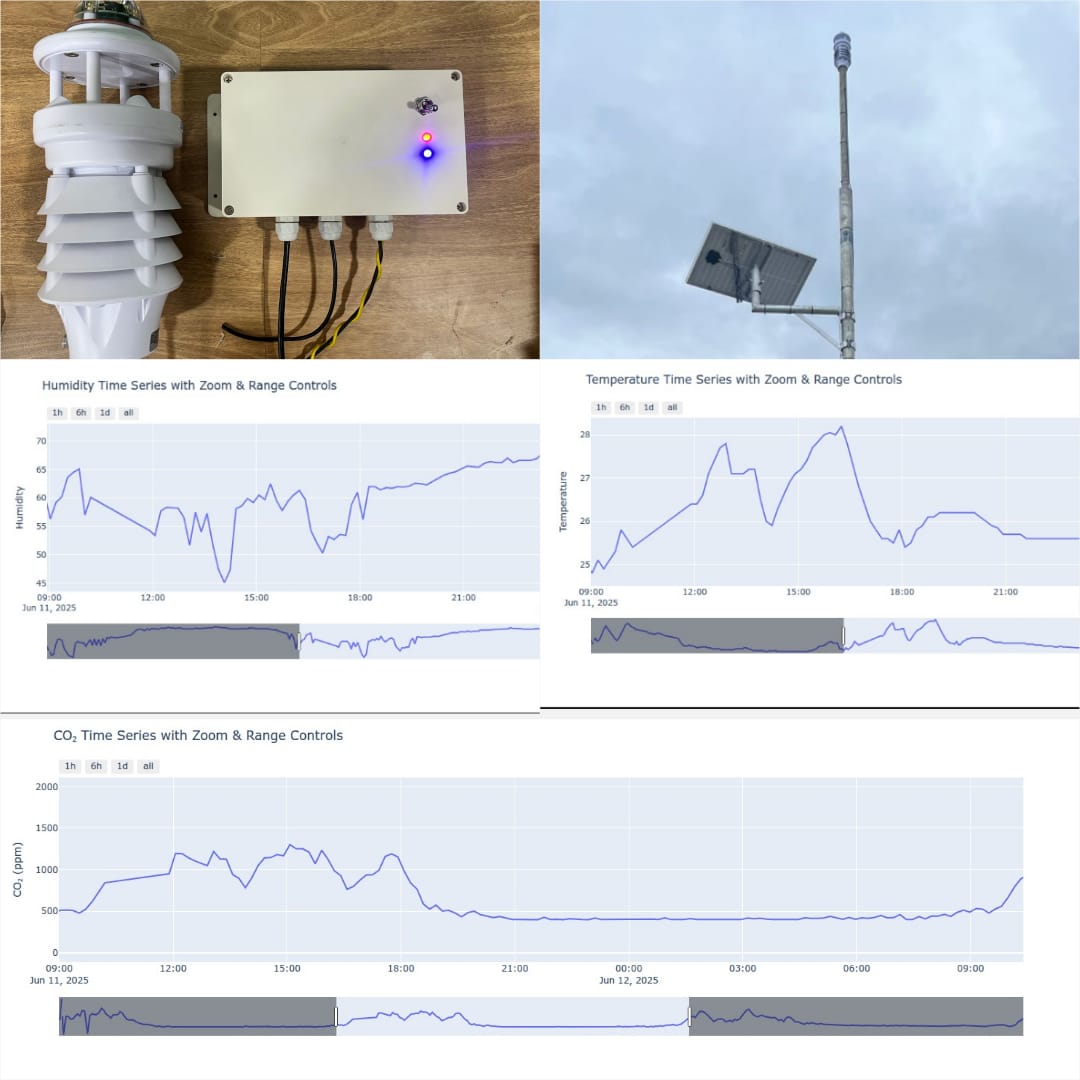
A solar-powered ESP32 weather station that monitors temperature, humidity, CO₂, light intensity, wind, PM2.5, and PM10 using RS485-connected sensors and GSM-based remote communication.
Next Step
We can discuss the sensing strategy, embedded logic, connectivity approach, and software visibility that make the solution practical in the field.